

Modern science, in its current form, is grounded in naturalism. It investigates only physical processes and phenomena, relying on empirical observation and rational analysis. This approach, referred to as naturalistic or secular science focuses exclusively on material realities. However, many important aspects of this world are non-physical. Life itself is one such non-physical entity and naturalistic science lacks the ability to fully comprehend it.
1. Did life emerge out of chemical reactions ?
Secular science tends to reduce life as an outcome of random chemical reactions. This is due to the limited scope of science to explain everything based on natural and physical phenomena. However, despite significant advances in molecular biology, the spontaneous generation of life in laboratory settings has never been achieved. While the chemical composition of cells is well understood, the emergence of life from these chemicals has not been achieved. Rather, the only known way to generate life is through other living beings (e.g. seeds from trees). When an inanimate thing acquires life, such as a seed germinating and splitting, life brings with itself agency and purposiveness. In the case of a tree, life orchestrates the actions to convert a simple seed into roots, leaves, stem capable of various kinds of operations to extract nutrients and water from soil, pass them upwards against gravity through complex mechanisms such as osmosis and transpiration, enable the leaves to capture energy from sunlight through photosynthesis and convert them into fruits and vegetables. One might argue that the DNA (or RNA in case of plants) encodes the information to do these actions. While the DNA encodes the code to create proteins which are building blocks for a living organism, it is just information. It is equivalent to a recipe in the cookbook, an active agent (a cook) is needed to interpret the recipe, bring the necessary ingredients to create the dish. Life brings with itself the agency to use this information to orchestrate complex actions. Life does not emerge out of chemical reactions but rather life is an active agent which rules matter. “Life unifies seemingly unrelated and unconnected constituents under one rule and subjugates them to one code of conduct within the domain of life. No matter how large or complex a living organism is, it functions as ‘one’ with definite borders – like a car with thousands of parts acting together as one entity at the command of a driver” [1].
How this life appears – such as within a seed or an embryo, is beyond the realm of science as it is not a consequence of chemical reactions. It is an external entity, and one with agency and purpose that is bestowed on inept matter by a Supreme Being Who holds all Intelligence and Power. The Holy Quran states – “He (God) ˹alone˺ gives life and causes death” (part of Ch44, Verse 8). “Life is like an invisible glue that transfuses into all constituents and holds the physical body of a living organism together as one to maintain wholeness within its boundaries. It seems like all the activities in a living organism serve life and work toward maintaining life and integrity. When an organism dies, it loses its integrity. The dead body starts to disintegrate as if the invisible glue has disappeared, and the parts become untied and fall apart. Therefore, an organism is much more than a collection of chemically active molecules.“ [1]
When a baby is formed in the womb of the mother, a complex set of actions are orchestrated to construct the various organs of the body and make them work in unison. The knowledge required to orchestrate this cannot be claimed to be present in the mother’s brain or that of the baby (which is still being formed). The knowledge and understanding of a single organ (say Kidney or brain) is its own field of extensive study and it has not been possible to create an organ from using its chemical constituents. There has been some research where tissue/organs are grown from stem cells. However these stem cells are living cells acquired from a living being. What we are referring to here is the ability to form a working organ purely from the chemical elements it is made of (such as carbon, nitrogen, phosphorus etc.) and it has not been even remotely achievable. There is a supernatural force which through the gift of life is orchestrating the formation of the baby and its organs. God Almighty states – “Or were they created by nothing, or are they ˹their own˺ creators? Or did they create the heavens and the earth? In fact, they have no certainty” [Holy Quran 52:35-36]
2. Does the soul exist ?
“And they ask you about the soul. Say: The soul is one of the commands of my Lord, and you ˹O humanity˺ have been given but little knowledge.” [Holy Quran 17:85]
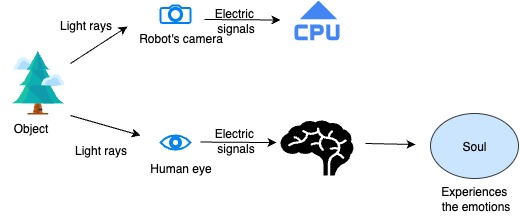
Let us compare the vision of a robot with that of a human being. A robot’s camera captures light, converts it to electric signals, which are then sent to the Central Processing Unit (CPU). The CPU analyzes this data in the form of 0s and 1s, applying algorithms it has been programmed with to make decisions. For instance, using computer vision algorithms it can identify that there is a person standing in front of the robot and can even match her face to the unique person’s id from its database. In the case of the human, your eye captures the light signals, converts them into electric signals and sends them to your brain. The brain processes and analyzes the data and matches the person standing in front to be your mother whom you are meeting after a while. But what happens after this is unique to a living being with a soul. The brain presents this information to your soul and it is your soul that experiences the sight and feels the joy and emotion of seeing your mother in front of you. The brain does not have any light waves or sound waves but just electric signals. But the person experiences the vision and enjoys it (unlike the CPU of a robot which is just processing the data in the form of 1s and 0s). One might argue that happiness is a chemical process with hormones such as dopamine, endorphins being released during happiness. It is even possible to stimulate transient happiness using such chemicals. While we understand some of the chemical reactions which happen in the body during emotions it does not take away the fact that the soul is the one which is experiencing that emotion. This shows the presence of the non-physical soul/life within a person.
3. Evolution of organisms
According to the theory of evolution, animals evolved from simple unicellular organisms into more complex ones through the process of natural selection and random mutations. While Islam does not reject the possibility of evolution occurring among animals, it is not a blind random process. Let us see why.
Even the simplest unicellular organism has around 160k base pairs in its chromosome. This means an ordering of 4 possible base pairs which leads to 4^160k possibilities (which is an astronomically huge number, with more than 100,000 digits), out of which only few would lead to a functioning organism. The probability of the right sequence of combinations of base pairs to be arranged through a random game of chance is so low that according to Fred Hoyle, a British astronomer and the inventor of stellar nucleosynthesis, the random emergence of a single living cell is akin to “a tornado sweeping through a junk-yard might assemble a Boeing 747 from the materials therein”
Further, complex features which involve intricate design cannot be created through random mutations and natural selection. The Holy Quran asks us to ponder over the creation of Camels. The camel has unique features such as snowshoe shaped feet which prevents them from sinking in the desert sand, papillae (cone-shaped, fleshy protrusions that help camels eat thorny cactus without injury) and 2 layers of eye lashes to protect against sand storms. The camelid ancestors are thought to have originated in South America and migrated to other places such as the Arabian desert. These camelid ancestors did not have these precise unique features of today’s camel. For them to develop these features through random evolution then these 2 things need to happen 1) Random mutations should cause gradual development of these features 2) Through natural selection, the camels with these advantageous features (such as keratinized papillae) would survive and their progeny who have these features will continue. First, random mutations leading to fully functional new design and features have not been observed in action. For instance, a human baby with snowshoe shaped feet or a cow with functioning papillae have never been observed though we have billions of these organisms. Even if random mutations led to the formation of these unique features in a camel, for natural selection to occur there must be a thriving community in that environment. If the camel ancestors without these features crossed over to the Arabian desert, they cannot even survive and thrive for a few weeks leave alone the millions of years needed for natural selection of camels with such advantageous features (such as keratinized papillae). Hence the natural selection process could not be even possible. This is not to reject the hypothesis that camels or other organisms went through genetic changes which enabled them to build features and adapt to their environment. However, as described earlier this could not be a result of random mutations, but rather it is the work of an All-powerful, All-caring Supreme Being who endows each organism with its means of survival. [Moses] said: “Our Lord is He Who gave to each thing its form and nature, then guided it aright.” [Holy Quran 20:40]
Another example is that of honey bees. They have complex social structures and features. A worker bee in its short life span of around 6 weeks performs a variety of activities. When it is 1 week or so, it can produce royal jelly from a gland and is used to feed the Queen. In around 2 weeks, its glands can produce wax used in construction of the hive. In around 4 weeks, they work as foragers travelling long distances to collect nectar and pollen. The unique features these bees have such as glands to produce different kinds of substances, specialized honey stomachs to carry nectar up to half their body weight and ability to find their way back to their hive from long distances all require precise design. Further, the worker bees do not reproduce and hence the evolution theory’s idea of each organism being motivated to pass on its genetic material does not apply here. Further, the honey produced is a source of nutrition and medication for humans. It cannot be a random stroke of luck that a group of insects produce a liquid that has benefit for humans.
Your Lord revealed to the bees: “Build dwellings in the mountains and the trees, and also in the structures which men erect. Then eat from every kind of fruit and travel the paths of your Lord, which have been made easy for you to follow.” From inside them comes a drink of varying colors, containing healing for mankind. There is certainly a Sign in that for people who reflect. [Holy Quran: 16:69]
4. Did Humans Evolve ?
All Abrahamic religions reject the notion of humans evolving from apes. The so-called evidence given for apes evolving into humans, are 1) closeness between the DNA of humans and apes 2) fossil records of apes or apelike creatures before first fossils of humans were found. One type of organism existing before another organism is not proof of evolution of the latter from the former. No direct evidence of this transformation has been observed, at least for humans.
Let us analyze the claim of closeness between Human DNA and Ape DNA as evidence for human evolution. The DNA contains coding for proteins which are building blocks for various organs in the body. This is a mechanism God has chosen to construct the physical bodies of the organisms. However, the DNA itself does not completely define an organism. The life or soul given to the organism is what makes the inept matter in it alive and rules over it. Humans have been given unique characteristics which neither evolution nor the DNA coding can explain.
1. Shame and modesty
Humans have a sense of shame and modesty which no other organism possesses. There is no evolutionary reason why humans should acquire a sense of modesty. In evolution, the goal of an organism is to maximize the transfer of its genetic material through reproduction. Modesty and chastity are a hindrance to it.
Further, animals have thick skin and body hair which prevents them from having a need for clothing. An advanced evolved organism such as humans, could have had those characteristics and not need clothes. But rather humans, even when there is no physical need to wear clothes, wear them due to a sense of modesty.
2. Justice and morality
Justice and morality are innate to the human soul: Humans value justice and morality. Evolution is about natural selection, wherein each organism is trying to survive and pass on its genetic material. This should lead to organisms developing any means of survival – for example, ideals that are apparently beneficial for survival such as deception, theft etc. could be valued. However the human soul rather despises deception and oppression.
3. Language – ability to speak and write
Language is a unique ability which humans possess. Though there are thousands of languages in the world, a child can learn any of the languages as much of the abstract concepts represented through language are shared. Every human is born with the innate capability to learn language. You cannot make a Chimpanzee speak though its genetic content could be very similar to humans. Though other organisms can communicate using sounds such as for warning against a potential predator, they do not have the expressive power and complexity of human language.
“He (God) created man. He taught him eloquent speech” [Holy Quran: 55:3-4]
With language, humans express abstract concepts like justice and love, future possibilities and imaginations, complex sequences of actions and events, explanations of causes and effects and so much more. This unique ability has led to civilization and human progress.
4. Ability to domesticate and control animals
Humans are the only species who can control and extract labor out of other organisms. While this is in part due to the intellect humans are blessed with, the other part is due to the inherent nature in some animals to be domesticated. Horses and zebras are from the same equine family and horses tend to be on average stronger and larger than zebras. However zebras cannot be domesticated while horses have their innate nature that makes domestication by humans possible. This is not explained by evolution, as a horse can easily survive in the wild without human help. Further some horses are extremely courageous and hence were widely used in warfare. Despite their courage and strength, they obey their human master who is much weaker physically.
“so that you may sit firmly on their backs, and remember your Lord’s blessings once you are settled on them, saying, ‘Glory be to the One Who has subjected these for us, for we could have never done so ˹on our own’” [Holy Quran 43:13]
5. Deep seated desire to be grateful
Human beings greatly value gratitude. In fact practicing gratitude is heavily stressed to maintain sound mental health. Inept matter which gains life through random chemical reactions and evolves through random mutations and ruthless natural selection would have nothing to do with gratitude.
A final thought to ponder about. When archeologists dig the ground and find the remains of pottery or a tool, this is attributed to the intelligence of the people at that time. However, when a fossil is found, though it indicates a much more complex and functional design than pottery, it is attributed to random purposeless evolutionary process rather than the All-Wise Being Who created it.
And if you should count the favors of God, you could not enumerate them. Indeed, mankind is [generally] most unjust and ungrateful. (Holy Quan 14:34)
Conclusion
The beginning of life is a mystery that has amazed humankind for centuries. Although scientific advancements have uncovered the structure of the universe, the makeup of cells, and the complexity of DNA, the explanation of life’s very first moment still remains a challenge. Is life merely the result of random chemical events, or is there an intelligent Creator behind it?
Over time, various theories have been proposed — such as the “primordial broth” theory, chemical evolution, and the idea that life’s seeds came from beyond Earth. However, modern biology suggests that the structure of cells, the coding system of DNA, and the specificity of enzymes are unlikely to have arisen by chance. For example, DNA functions like an information system, complete with a language, storage, and transmission. Such an organization seems logically impossible to emerge on its own.
Furthermore, scientists have observed the incredible complexity within the machinery of the cell, such as ribosomes and mitochondria, whose precise arrangement and function appear impossible without intelligent planning. If life was created with purpose, then the question arises: Who designed this plan?
The idea that matter alone could give rise to life, consciousness, and knowledge seems far from reasonable. That’s why many scientists and thinkers have concluded that the origin of life points to a wise and all-knowing Creator.
This research highlights the fact that when we reflect on the beginning of life, we must consider not only chemistry, biology, and physics—but also the deep wisdom and intention behind life.
References
- Çengel, Y. A. “Eighteen distinctive characteristics of life. Heliyon, 9 (3), e13603.” 2023,